How to make your dreams come true
My husband and I are fortunate to have jobs in technology, but we’ve also experienced financial setbacks and leaner periods because of layoffs and other life circumstances. I will acknowledge we are privileged to be able to travel at all. So acknowledging that some resources are required, I want to talk about a way of doing things that can help you make things happen.
I get excited about “making things happen.” I’m a technical project manager and a personal finance nut, so naturally I’ve turned our travel dreams into something resembling a planning process.
These ideas could apply to all kinds of financial goals, but I’m going to explain them through the lens of adventure travel.
If you are familiar with technical project management terms you will see them used throughout.
Get Your Financial Priorities in Order
First things first, taking time and money for travel means getting your financial priorities in line. There is so much to say about this, but it goes without saying (even though I’m saying it), that you have to take care of the essentials before you save for the non-essentials. (Here’s a starting point Reading List)
If you are not familiar with Ramit Sethi’s “Rich Life” philosophy, I recommend this and his podcast as a way to consider and plan your financial life. No kickbacks here, I just love Ramit’s approach and recommend it. If you are in debt, or don’t know where your money is going, these resources will help as well as the tools I list. This post is more focused on goal setting beyond the essentials. Ramit covers it all.
One thing I love about Ramit’s approach is it talks about defining what makes me happy and carving it out in my finances as a priority. Finances reflect our priorities and they can do more so when we are intentional, and our spending is aligned with higher goals, not low value purchases.
For me, travel is one of those priorities, especially cycling and adventure travel. If that's important to you too, you need to know where your money is going and deliberately make room for it.
Use Tools to Make your Money Transparent
Given how complicated life is, it’s very difficult to look at the number in a bank account and figure out how that number is going to turn into all these wonderful things. Don’t try, use a computer!
I use apps to keep track of my spending as follows:
YNAB: day-to-day budgeting and saving toward specific goals
Google Sheets: financial planning, analysis and optimization
Empower: big-picture and long-term tracking
A good budgeting app has become critical to this process for me. I used to use Rocket Money primarily to track my finances, but I’ve since switched to YNAB. The big difference for me is that YNAB gives me much more fine-grained control over what the money I already have needs to do.
I now have more than 80 categories for everything from groceries to a car down payment five years from now. I couldn’t realistically maintain that level of detail manually, and I wouldn’t want to.
I’ve also heard good things about Monarch Money and Actual Budget, although I haven’t used them myself.
Build and Roughly Size Your Travel Backlog
Before deciding what to book, make a list of the trips you want to take.
If you’re familiar with Agile planning, think of this as T-shirt sizing. You don’t need to research airfare, hotels and rental cars and build a detailed budget for every trip you might someday take. At this point, you just need enough information to roughly compare them.
We classify ours as A, B and C trips based on the amount of money, time and effort they’re likely to require:
A trips: The big ones. These might be international trips or destinations that are expensive or time-consuming to reach.
B trips: Medium-sized trips. For us, these might involve flights and a rental car, or a longer road trip with several nights away.
C trips: Smaller trips that are easier to fit into our lives and budget. These are often drivable micro-adventures, weekends away and shorter cycling trips.
The point isn’t to decide that we’ll take exactly one A trip, two B trips and four C trips every year. It’s a quick way to size the backlog before we’ve done the work of creating a real budget. Once a trip moves into active planning, we’ll replace that rough estimate with actual numbers.
We also like asking ourselves whether we can turn a B trip into a C trip. Could we drive instead of fly? Camp for a night or two? Combine destinations into a longer road trip? Sometimes changing how we travel changes the economics of the trip considerably.

Keep a Trip Backlog Separate from your Plans
This is where my project manager brain takes over.
I keep a backlog of trips we want to take. The backlog is just a holding place for ideas and dreams- it isn’t a commitment to do all of them. We maintain it regularly and review it regularly.
You can keep this in notes or a spreadsheet and add whatever information helps you compare your options: A/B/C classification, estimated cost, number of days, amount of PTO required, ideal season or anything else that matters to you.
This does two useful things. First, you don’t lose the idea. Second, you don’t have to act on every exciting travel idea the minute you have it.
In separating the dreams from the plans, you can have a huge travel wish list without pretending you can afford all of it right now, and taking the transition seriously of a dream to a real plan. This is eary for
Give Travel a Monthly Budget
Travel expenses can pummel a monthly budget when they arrive in big chunks: $900 for airfare one month, $1,200 for a hotel the next, then a rental car and meals once you actually get there.
We’ve started treating travel as a regular monthly cost instead.
My husband and I decide how much each of us can contribute to travel every month. We transfer those contributions into a shared bank account and have a separate YNAB budget connected to that account.
That gives us a fixed amount of money to work with. The question then becomes: What trips can this money realistically fund?
Move Trips From the Backlog Into the Plan
If you’re familiar with Agile methodologies, you may see where this is going.
You don’t work every item in a product backlog simultaneously. You prioritize a manageable number of them while the rest remain in the backlog. We now do essentially the same thing with travel.
A handful of trips move from our wish list into active planning. The rest stay safely in the backlog until we have the money, time and desire to prioritize them.
This is an important distinction. Putting something in the backlog doesn’t mean no. It means not yet.
You can use separate bank accounts or a budgeting app to keep this separate from your other spending. In either case, protect it like a baby endangered animal!
Fund the Plan Over Time
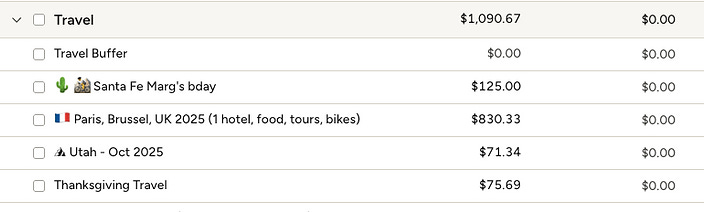
For every trip we move into active planning, we create a category in YNAB.
Then we give it two things:
A target amount and a target date.
Estimate the whole cost of the trip—not just airfare and lodging. Think about transportation, food, activities, parking, fees and all the miscellaneous spending that happens once you’re there.
If you’re using hotel points, airline miles or free-night awards, factor those in too. But remember that a “free” hotel room doesn’t make the trip free. We once spent a ton of money on a trip where our lodging was completely covered. It sounds obvious. Somehow it isn’t always obvious when you’re booking the trip.
YNAB calculates how much we need to contribute each month to reach each target. Then we can adjust the plans until the monthly amount required lines up with the money we’re actually contributing.
Maybe your budget supports one big trip a year. Maybe it supports six smaller ones. Either is great.
The important change for us is this:
The available travel money determines how many trips move into the plan, not the other way around.
You can also keep a savings goal intentionally vague. Instead of funding “Italy,” you might fund “Summer 2027” and decide on the destination later. That gives you room to take advantage of airfare deals, change your mind or choose an adventure based on how much you’ve actually saved.
And don’t be afraid to leave something in the backlog. A trip you can’t fund right now isn’t a trip you can never take. It just isn’t in this planning cycle.
Save Before You Commit
We blew through our travel budget one year, so this is the part of the new system I’m most excited about.
We’re trying to save before we commit to a trip- or, at minimum, know exactly how we’re going to pay for it before we book it.
That doesn’t mean we need every dollar sitting in an account before making a reservation months in advance. It means the trip has a realistic cost, a target date and a monthly funding plan that fits within the amount we’ve decided we can spend on travel.
Once the categories are set up and the monthly savings are aligned with them, there’s really not much left to do except keep funding them and watch them grow.
The goal isn’t to travel less. It’s to travel without having every adventure become a financial surprise.
YNAB is not a sponsor. I just genuinely love the software.